Your False Accusation Response Checklist is on its way. While you wait, please read what is on this page carefully. Because the checklist covers the first 48 hours. What is on this page covers everything after.
Someone Lied About You. People Believed It. And Right Now Every Move You Make Could Either Protect You or Cost You Everything.
Discover The Complete Framework For Fighting Back Against A False Accusation, Stopping The Damage Before It Becomes Permanent, And Taking Back Control Of Your Name, Your Career, And Your Life...
Without Saying The Wrong Thing, Without Missing The Windows That Close, And Without Spending Another Day Navigating The Most Critical Situation Of Your Life Without A Map.
Here is how I fought back, and what I learned that I could not find anywhere else.
I Was Falsely Accused. Facing Decades Behind Bars. Alone in a Foreign Country With Everything I Had Built Hanging in the Balance.
I was ready to retire. I had one thing I was looking forward to more than anything else: attending my daughter's university orientation in Texas.
Everything I had worked for, everything I had sacrificed, was finally about to pay off in the way that actually mattered.
Then my retirement request was denied.
I was forced into one more deployment to the Middle East. I told myself it was just one more year. I would fulfill my duty and come home.
What happened instead changed everything.
In a foreign land, far from my family and far from anyone I could trust, I was falsely accused of something I did not do. A charge that carried the threat of a decades-long prison sentence. I was stranded. Stripped of my honor. And in a military culture where an allegation alone is enough to end a career, allies were almost impossible to find.
I had to fight. Without a roadmap. Without a clear understanding of my rights. Without anyone handing me a framework. I built it myself, under the worst possible pressure, with my freedom and my future on the line.
I won. And I wrote about that fight in my book, Liar, Liar, Soldier on Fire.
Then I built what you are reading about right now, because no one should have to figure this out alone the way I did.
Everything here came from that experience. Not from research. Not from theory. From the reality of being falsely accused at the most serious level possible, and finding a way through it with my name and my integrity intact.
If you are in this right now, keep reading. This was built for you.
BEFORE YOU KEEP SCROLLING...
Here Is the Brutal Truth About Why Innocent People Lose This Fight Every Single Day.
You found out someone said something...
Maybe it was a screenshot. Maybe it was a phone call. Maybe you read it online and had to read it twice because your brain refused to take it in the first time. And then your body did something strange. Your hands went cold. Your chest tightened. And somewhere underneath all of it was a single, horrifying question: what do I do now?
Let me tell you something that nobody else is going to tell you in the next few hours.
That feeling... the panic, the rage, the urge to go straight at this and fight it with everything you have... it is trying to help you.
It is just trying to help you in all the wrong ways.
The instinct to confront. To post. To call everyone who matters and explain yourself before they hear it somewhere else.
To send the message you have been drafting in your head for the last hour. To correct the record immediately, loudly, without stopping, until people understand what is actually true.
Those instincts come from a real place. They come from the part of you that knows the truth and cannot stand watching it being buried under someone else's lie. In almost every other situation of your life, those instincts would serve you. They would get results.
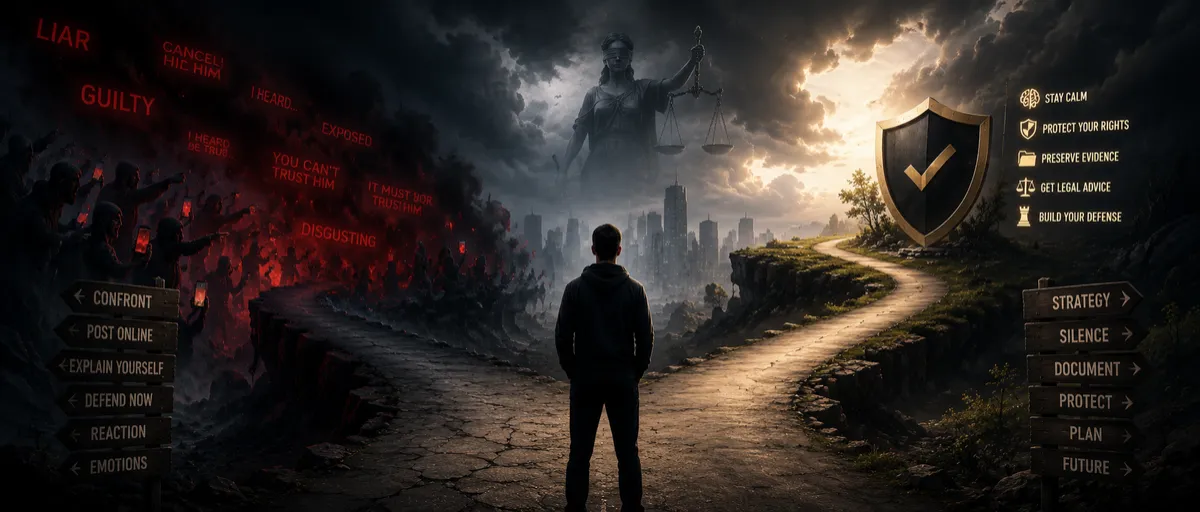
This is not almost every other situation of your life.
What you are facing right now is not a conversation you can win by talking louder. It is not a reputation you can save by explaining more thoroughly. It is not a situation that will resolve itself once people see how sincere and committed to the truth you are.
Innocence is not a defense strategy. It is not enough on its own. It never has been. And the sooner you understand that, the sooner the fog starts to clear and you can see what actually is.
The people who protect their careers, their relationships, and their name when a false accusation lands on them are not more innocent than you. They are not luckier. They are not better connected or wealthier or more respected in their industry. They are not people who simply hoped the truth would eventually come out on its own.
They understood something most people only learn after it is too late. They understood that false accusations, as unjust as they are, follow a pattern. That pattern has a response. That response, applied in the right order at the right moments, changes what is possible from here. Significantly.
That response is exactly what this course is built to teach you.
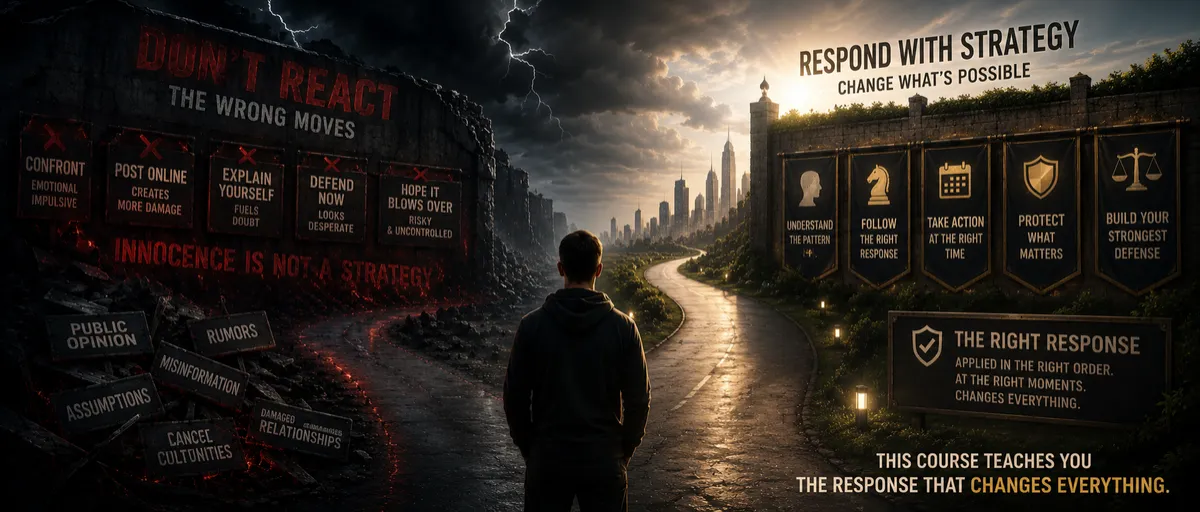
"The people who come out of a false accusation with their career, their reputation, and their life intact are not the ones who were more innocent than you. They are the ones who learned the framework early enough to use it. That is what changed everything for them. That is what can change things from here for you."
WHAT'S ACTUALLY HAPPENING:
Innocence Is Not a Defense Strategy. And That Is the Reason Good People Keep Losing.
Here is what I know about you right now. Or the version of you reading this page.
You have probably already done several things. Posted something, or thought very hard about it. Explained yourself to someone who seemed to be listening. Confronted someone, or avoided them entirely. Spent time drafting a long, careful message that you went back and forth on whether to send. Maybe you sent it. And underneath all of that activity... the situation is not where you hoped it would be by now.
That is not a character failure. That is what happens when a person of good instincts faces a high-stakes situation without a framework built specifically for it.
The instincts that serve you in normal life, the ones that say speak up, explain yourself, treat people fairly and expect the same in return, those instincts were built for a world where reasonable people have a conversation and the truth settles things. They were not built for a false accusation.
The world a false accusation creates runs on documentation, legal procedure, and strategic communication. Not good intentions. Not emotional sincerity. Not the force of your conviction that you are right. Those things matter to you. They do not always matter to an HR process. They do not matter to a judge. They do not matter to a Google search result that has your name attached to something you never did.
Learning what does matter in that world, and in what order, and which moves to make when... that is the difference. That is the gap between the people who come through this and the people who don't.
The Four Reasons You’re Stuck
Your Instincts Are Working Against You Right Now. Here Is Exactly Why, and What to Do Instead.

Reason #1
You're Playing by the Rules of a Fair World. This Isn't One.
When someone treats you unjustly, every instinct you have says: respond with the truth. Speak up. Correct the record. Appeal to reason and decency and the basic human understanding that people should not be punished for things they did not do.
In a fair world, that works. But a false accusation is not a fair fight, and it never was. The person who made it chose the battlefield, chose the weapon, and chose the timing. You stepped onto that battlefield mid-battle, with no armor and no map. The first thing this course gives you is the map.
Reason #2
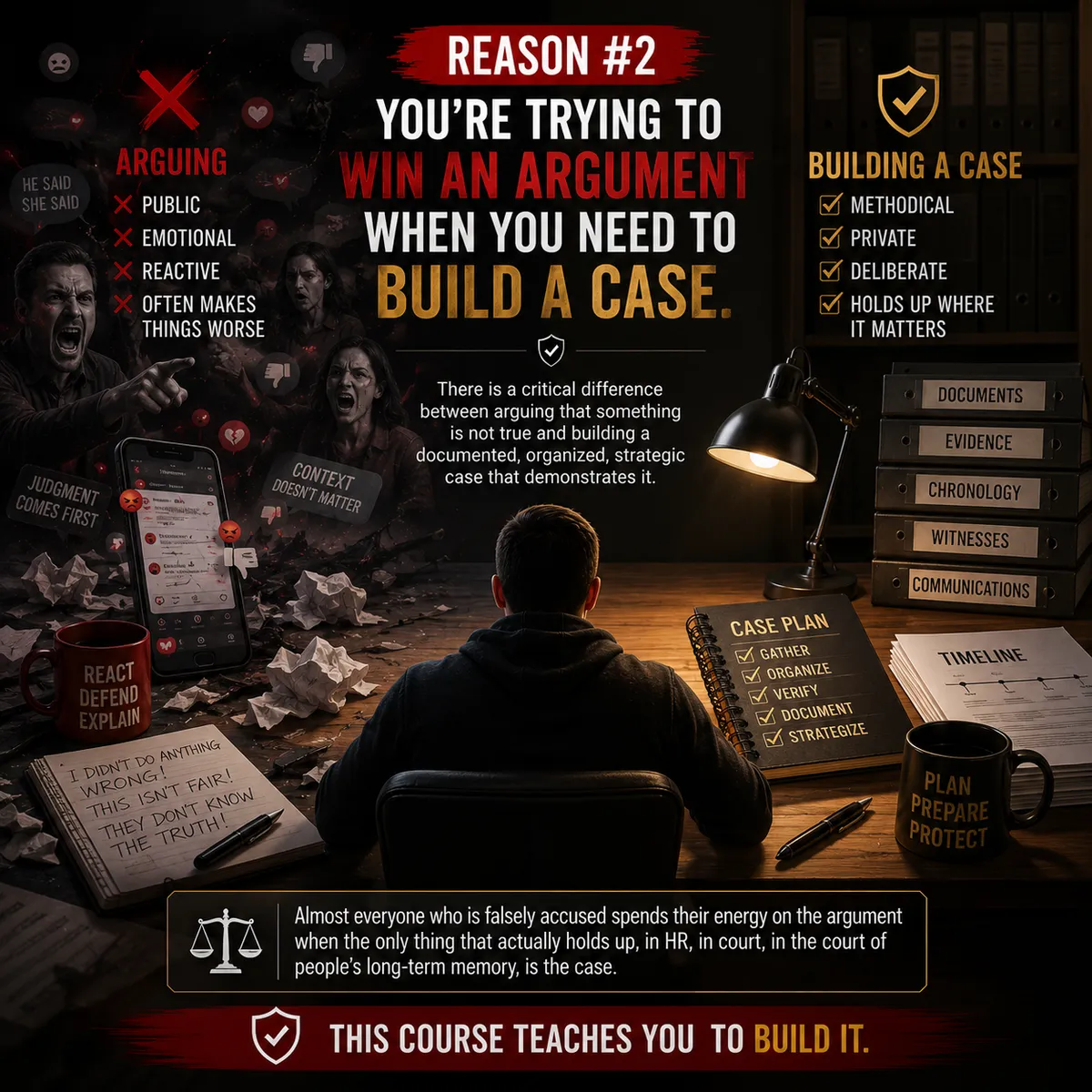
You're Trying to Win an Argument When You Need to Build a Case.
There is a critical difference between arguing that something is not true and building a documented, organized, strategic case that demonstrates it.
Arguing is public, emotional, reactive, and often makes things worse. Building a case is methodical, private, and deliberate, until the right moment, in the right context. Almost everyone who is falsely accused spends their energy on the argument when the only thing that actually holds up, in HR, in court, in the court of people's long-term memory, is the case. This course teaches you to build it.
Reason #3
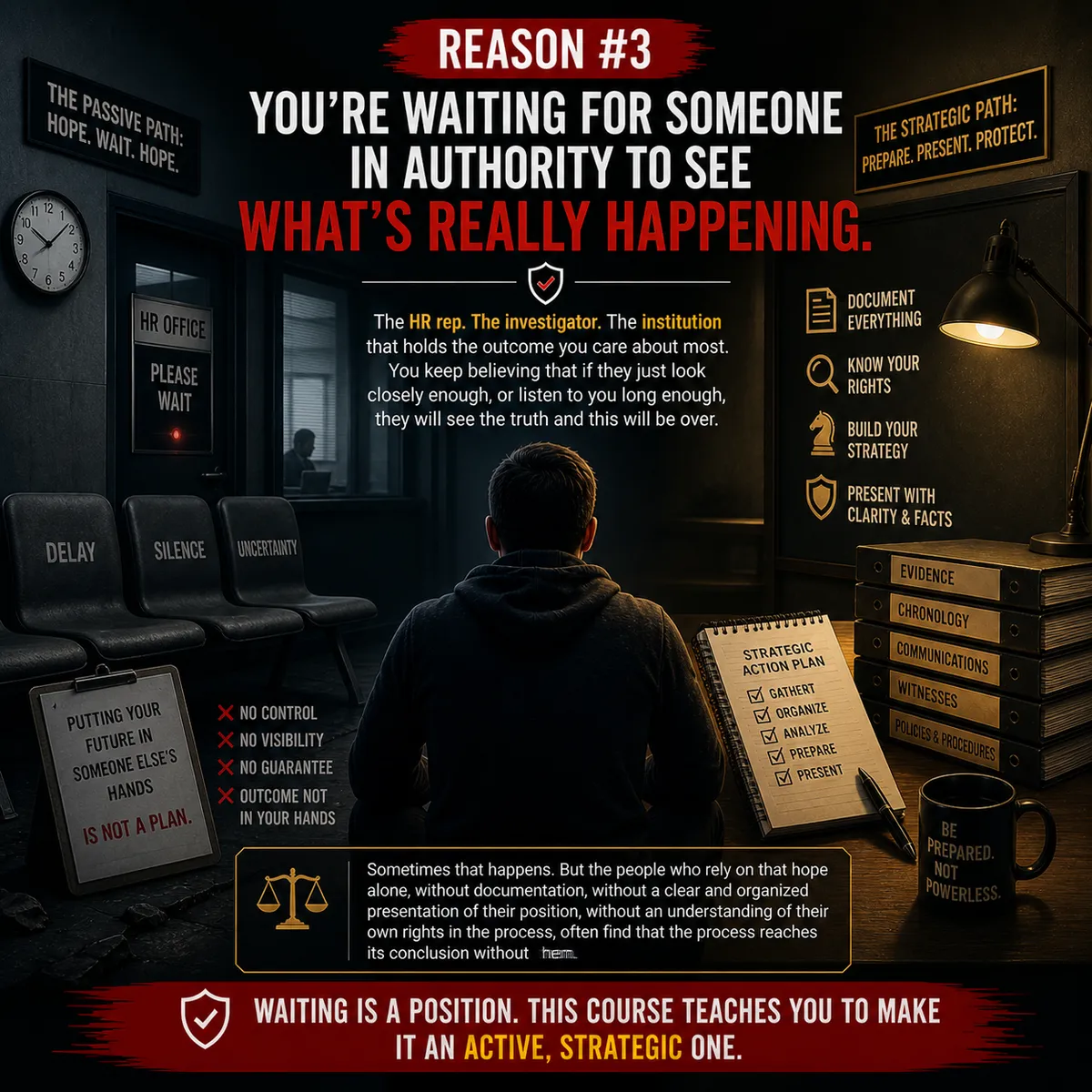
You're Waiting for Someone in Authority to See What's Really Happening.
The HR rep. The investigator. The institution that holds the outcome you care about most. You keep believing that if they just look closely enough, or listen to you long enough, they will see the truth and this will be over.
Sometimes that happens. But the people who rely on that hope alone, without documentation, without a clear and organized presentation of their position, without an understanding of their own rights in the process, often find that the process reaches its conclusion without them. Waiting is a position. This course teaches you to make it an active, strategic one.
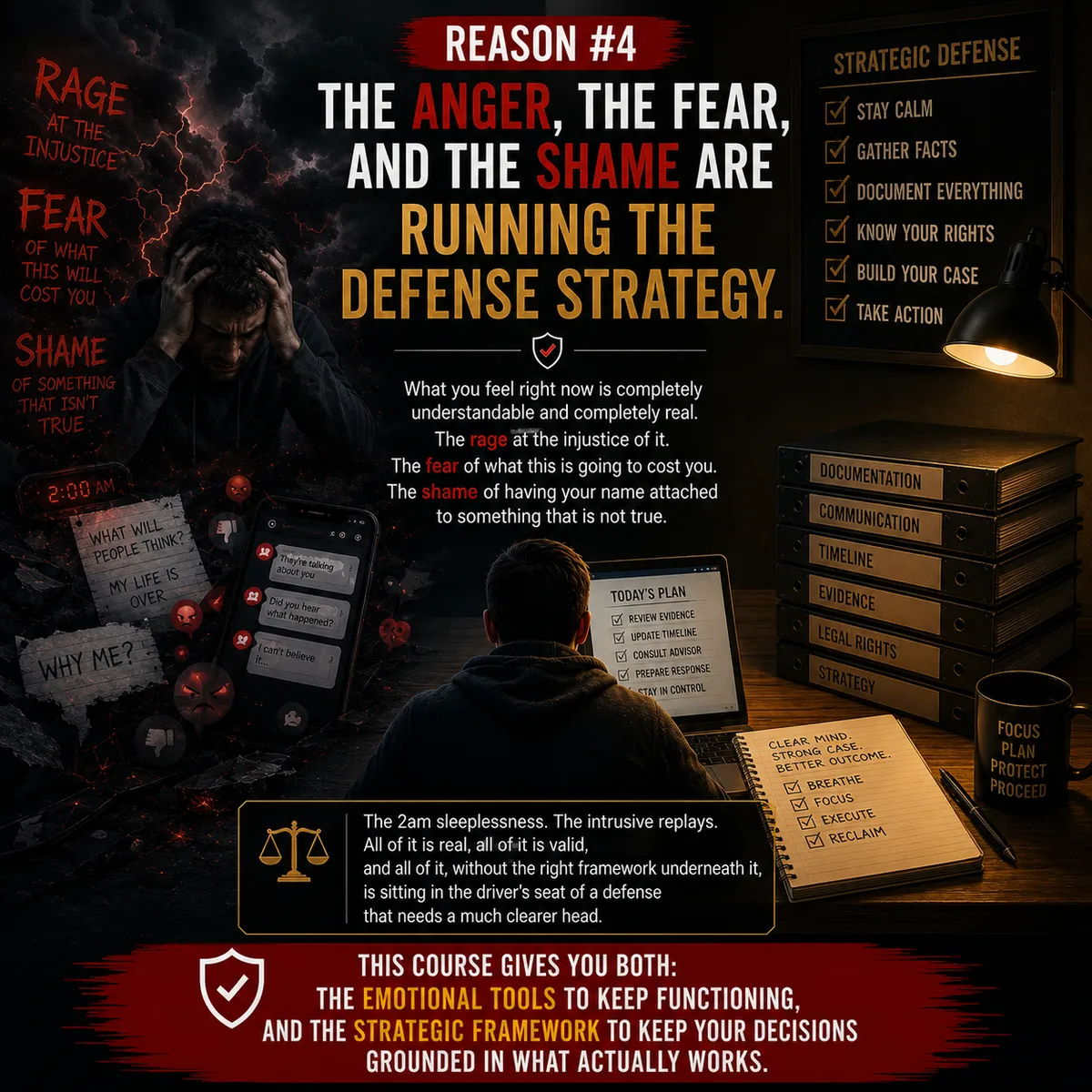
Reason #4
The Anger, the Fear, and the Shame Are Running the Defense Strategy.
What you feel right now is completely understandable and completely real. The rage at the injustice of it. The fear of what this is going to cost you. The shame of having your name attached to something that is not true.
The 2am sleeplessness. The intrusive replays. All of it is real, all of it is valid, and all of it, without the right framework underneath it, is sitting in the driver's seat of a defense that needs a much clearer head. This course gives you both: the emotional tools to keep functioning, and the strategic framework to keep your decisions grounded in what actually works.
You Have Two Choices Right Now
One Gets You Through This. The Other Makes Everything Harder to Fix.
I have lived both of these paths. The first one, reacting without a framework, almost cost me my freedom. The second one, building a deliberate, documented, strategic defense, is what brought me home.
If Nothing Changes…
X Keep making decisions at maximum emotional intensity with no ordered protocol to guide you, and keep producing the results that emotional decisions under pressure tend to produce
X Keep posting, confronting, explaining, and drafting responses that feel like the right thing to do, and find out later what they cost you in situations where the record matters
X Keep watching the people you care about go quiet, watching colleagues create distance, watching your name sit next to something you did not do, without a framework to address any of it
X Keep missing the documentation window, the legal window, the reputation window, because nobody told you those windows exist or that they close
X Keep carrying the full weight of this alone, with no framework for what it takes to stay functional, clear-headed, and strategic in the hardest situation you have likely ever faced
X Find out months from now, or in a hearing room, what you should have known and done in the first 72 hours
When You Say Yes Today
✓ Know exactly what to do in the next 24 hours, the next 72 hours, and the next 30 days, in a specific sequence that builds your defense instead of quietly undermining it
✓ Have a documented, organized evidence vault and defense timeline that serve you whether this situation resolves in two weeks or takes two years to work through
✓ Understand your legal rights in plain language, know what type of attorney you need and what is available at your budget level, and know what to do right now, before you have representation, to protect your position
✓ Have the emotional survival tools to keep functioning and thinking clearly, and a clear picture of what rebuilding looks like once the most acute phase is behind you
✓ Have a communication framework that tells you when to speak, when silence is the strongest move you can make, and exactly what to say when someone looks you in the eye and asks directly
✓ Have a complete online reputation roadmap, platform by platform, specific step by step, starting from wherever things stand right now and building toward where you need them to be
INTRODUCING
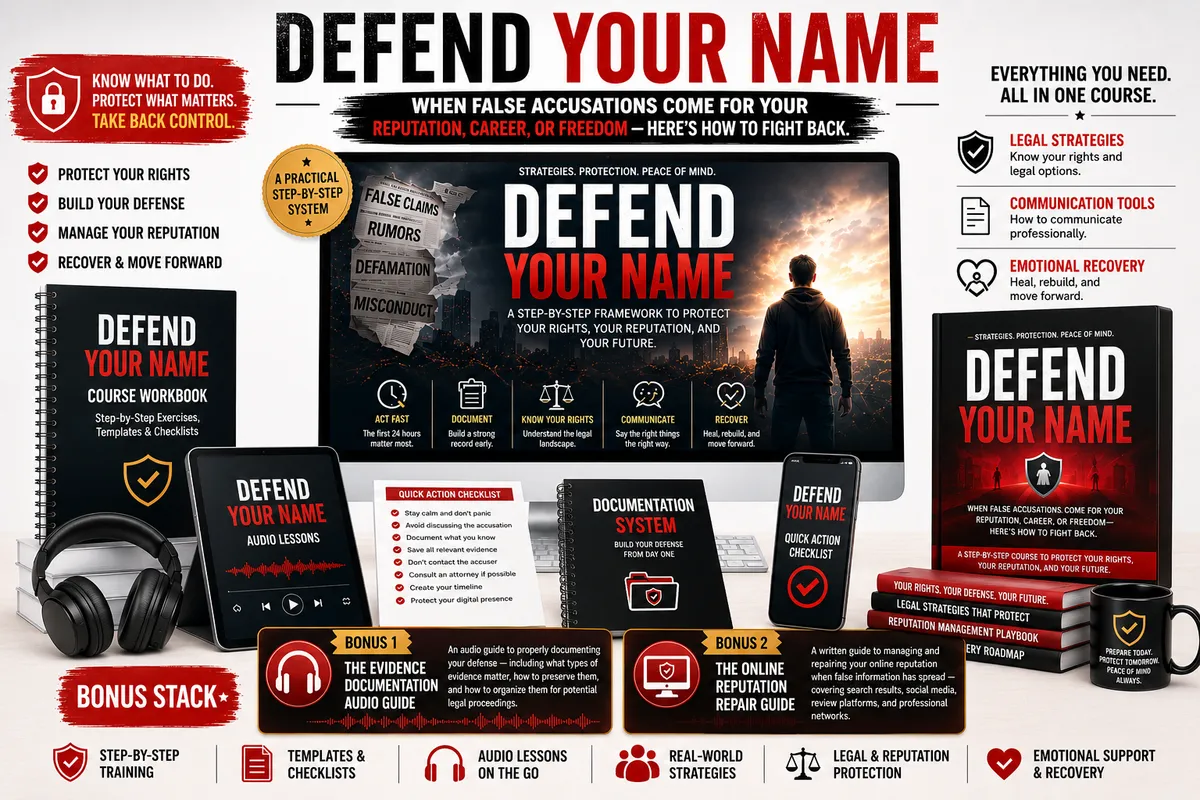
DEFEND YOUR NAME
The Strategic, Legal, and Communication Framework for Fighting Back Against a False Accusation, Protecting What You Have Built, and Coming Out of This With Your Life Intact.
Not a list of things to hope for. Not a motivational program that tells you the truth always wins. Not a collection of legal theories from people who have never sat where you are sitting right now.
A clear, four-module framework built specifically for the person dealing with a false accusation, or who wants to understand how this works before it ever arrives. Built for the real human experience of what this is: the shock, the legal maze, the communication minefield, the reputation damage that spreads faster than truth ever does, and the psychological weight that nobody around you fully understands unless they have been through it themselves.
Every lesson comes in text and audio. No video. No marathon sessions that demand an uninterrupted afternoon in a life that has not stopped being demanding just because this happened. Read it at 2am when you cannot sleep. Listen during your commute. Work through a lesson in the twenty minutes you carved out between everything else that still needs your attention. This was built for real people in a real crisis, not for people with perfect schedules and unlimited resources.
No legal background required. No prior knowledge assumed. Just a clear, ordered framework for every phase: the first hours, the documentation, the legal considerations, the communication strategy, the reputation management, and the emotional recovery. All of it. In one place. In the order that matters.
4
Focused Modules
20
Practical Lessons
2
Powerful Bonuses
System
For Life
This Was Built For You If...
This Was Built for One Very Specific Person. See If That Person Is You.
You Found Out in the Last 24 Hours and You Do Not Know What to Do First
The first 24 to 48 hours are the most critical and the most dangerous window in any false accusation situation, because you are making decisions at maximum emotional intensity with no framework to guide them. Module 1 starts right there: a specific, step-by-step protocol for the first hours, built for the person who is in the middle of it right now and cannot afford to learn the hard way what the right moves were.
Your Job, Your Career, or Your Professional License Is on the Line
When a false accusation enters a workplace, an HR process, a licensing board review, or any institutional investigation, it stops being only a personal crisis and becomes a professional emergency at the same time. This course includes dedicated content on your rights in institutional proceedings, how to navigate employer and professional communications without making things worse, and how to protect your career while the process unfolds around you.
You Have Already Said Too Much, Posted Something, or Made the Confrontation
Most people do not respond perfectly in the first hours of a false accusation. The instincts are understandable, and the instincts tend to be the wrong move. If you have already made some of those moves, this course is still built for you. The question is not what you should have done. The question is what to do from this moment forward. And this answers it clearly.
You Are Still Functioning. But Only Barely. And You Know It.
The experience of being falsely accused is genuinely traumatic. The shame you feel even though you did nothing wrong. The rage at the injustice. The grief over the relationships and opportunities already damaged. The isolation of going through something most people around you do not know how to hold space for. Module 4 is dedicated entirely to this reality, not as a footnote, but as a full module. Because surviving this strategically and surviving it as a human being are two different things, and you deserve both.
You Cannot Yet Afford an Attorney and That Feels Like a Wall
One of the most paralyzing feelings in a false accusation situation is the sense that you cannot protect yourself without legal representation you cannot afford. This course includes a full module on your options at every budget level: legal aid organizations, law school clinics, limited-scope representation, bar referral programs with reduced-cost consultations, and how to be your own best advocate in the situations where full representation is not yet possible. "I cannot afford a lawyer right now" is a real constraint. This course takes it seriously.
The Lie Is Already Out There, Online, In Your Industry, or In Your Community
Reputation damage from a false accusation does not wait for the truth to catch up. It spreads fast and it stays long. If false information is already circulating about you online or in your professional community, Module 3 and the included Online Reputation Repair Guide are built specifically for that reality: platform by platform, tactic by tactic, starting from wherever things stand right now.
GET THESE FREE WHEN YOU JOIN
Two Tools That Cover the Two Things People Struggle With Most: Building the Defense and Repairing the Damage Already Done.
These were not added to inflate a value stack. Each one was built to close a specific gap that the course content alone could not fully address: one for the critical first 48 hours when you need something you can hold in your hands and work through right now, and one for the long, grinding work of repairing what the lie already did to your name online.
BONUS #1
The Evidence
Documentation Audio Guide
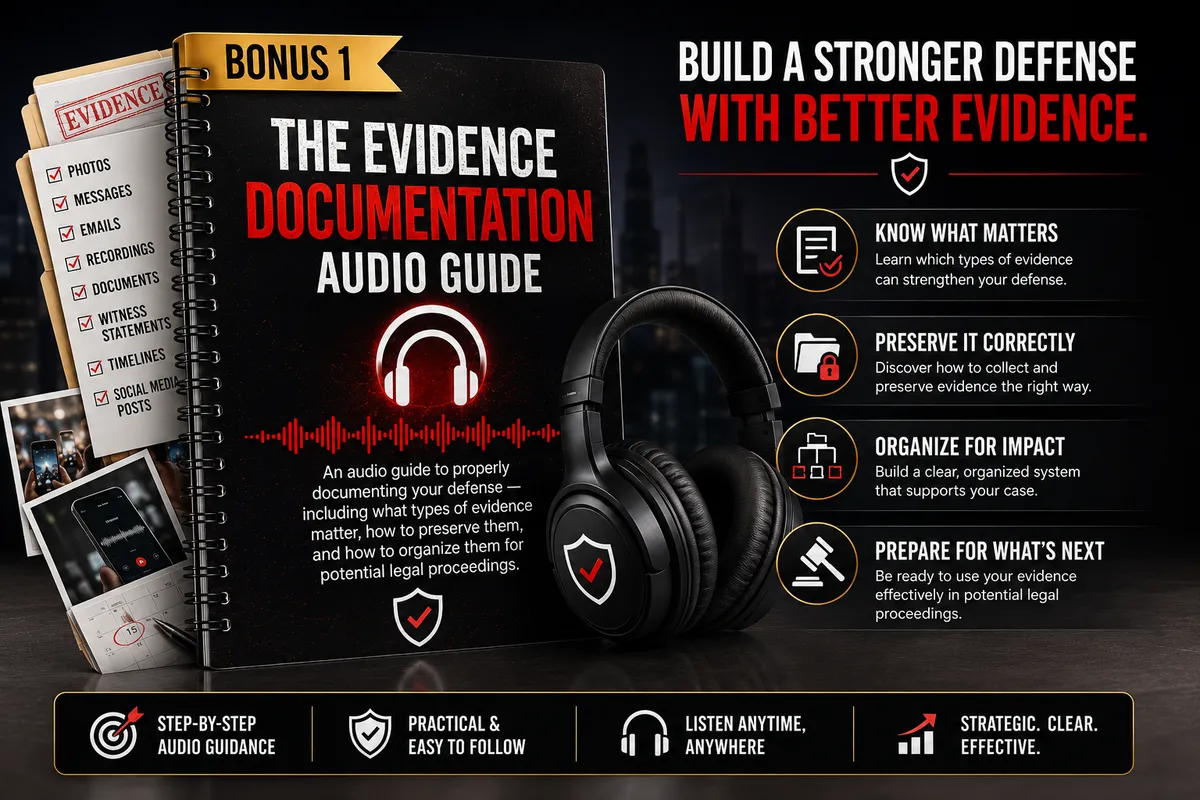
When most people think about "gathering evidence," they grab whatever they can find and hope it helps. That is not documentation. That is panic collecting. This audio guide walks you through the right way to build a documented defense from day one, so that everything you gather is preserved correctly, organized clearly, and actually useful when it matters most.
What types of evidence carry real weight in a false accusation situation, from digital communications and timestamped records to witness accounts and physical documentation, and which matter most depending on your specific type of case
How to preserve each type of evidence correctly so it remains intact and usable, including the common mistakes people make that accidentally compromise evidence they already have in their hands
How to build and organize an Evidence Vault structured so an attorney can step in and work with it immediately, without having to sort through a pile of screenshots and notes
The Defense Timeline method: how to reconstruct a documented chronological account of events that surfaces inconsistencies in the accusation and strengthens your position across every phase of the process
What not to do when collecting and preserving evidence, the moves that feel logical under pressure but can backfire legally or practically
FREE
Included instantly on enrollment
BONUS #2
The Online
Reputation Repair Guide
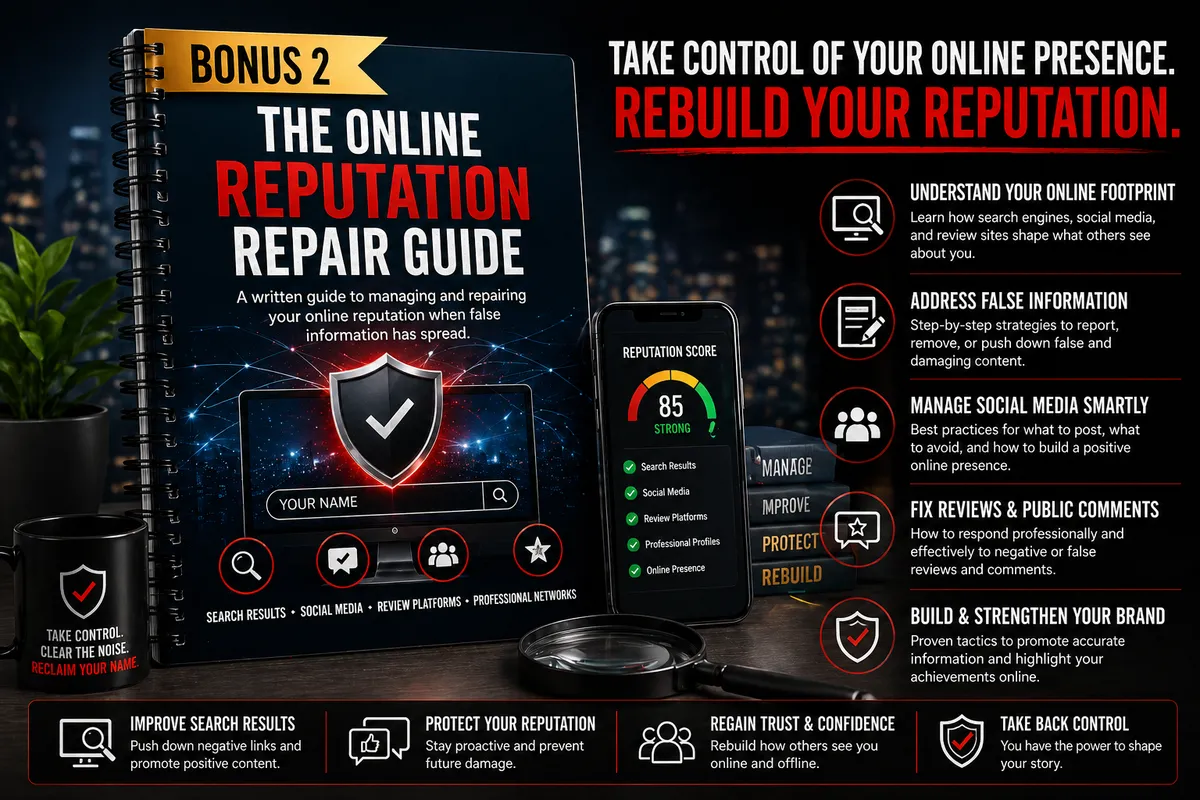
False accusations do not end when the accusation is addressed. The posts, the search results, the reviews, the forum threads... they keep existing. They keep showing up. They keep shaping what people think when they search your name. And most people have no idea what to actually do about it. This guide gives you a complete, platform-by-platform framework for addressing all of it, starting from an honest audit of where things stand right now.
The 5-part online audit process for mapping exactly what false or damaging content exists about you and where, before you take a single action
Search results strategy: the three-track approach to removal, de-indexing, and content suppression, including the content suppression method that works when removal is not possible
Social media action guide by platform: Facebook, Instagram, X, TikTok, YouTube, and Reddit, with specific reporting steps, removal request processes, and what to do when the platform does not act
Review platform response framework for Google Reviews, Yelp, Glassdoor, and specialty directories, including when to respond professionally and when not responding is the stronger move
LinkedIn and professional network strategy: the single most important platform for most people's professional reputation, and how to use it as an active defense tool, not just a passive profile
The 6-Month Digital Reputation Rebuild Plan: month by month, with specific deliverables at each phase, from Foundation through Content Seeds, Amplify, and Sustain
FREE
Included instantly on enrollment
WHAT YOU'LL LEARN
Here Is Every Single Thing You Will Learn, In the Exact Order That Actually Matters When Your Name Is on the Line.
Four focused modules. Twenty lessons. Each one builds on the last, so that by the end you do not just know more about how to handle a false accusation. You have a running defense: documented, organized, legally informed, and built for your actual situation. Not theory. A working framework you can act on immediately.
MODULE 1
The First 72 Hours: Stop the Bleeding Before You Build the Defense
The decisions made in the first three days of a false accusation either build your defense or undermine it. Most people make those decisions by instinct, under maximum pressure, with no framework to guide them. This module changes that from the very first lesson.
What you’ll learn here…
The 24-hour response protocol: exactly what to do and in what order in the first day, and the specific actions that feel instinctively right but are almost always the move that makes everything harder to fix later
The four psychological traps that drive most people to make their situation worse in the first hours: the urge to confront, the urge to broadcast, the urge to isolate, and the urge to do everything at once and right now
How to build your immediate support circle: who belongs in it, what to tell them, how to ask for the kind of help that actually helps, and what not to share even with the people you trust most
How to assess the full scope of what you are facing, from social and interpersonal accusations to professional and institutional to criminal, because the right response depends entirely on understanding which situation you are actually in
The documentation habit that starts protecting you from day one, because the record you build in the first 72 hours is the foundation everything else stands on
MODULE 2
Build Your Defense: Documentation, Evidence, and the Legal Framework
Module 1 gets you stable. Module 2 builds the foundation of your actual defense: a documented, organized, legally informed case that serves you whether this resolves in two weeks or takes two years.
What you'll learn here...
The Evidence Vault: how to build and organize a documented defense from day one, including the four categories every evidence system needs and the standard that makes your documentation useful to an attorney when you need one
The Defense Timeline: the single most powerful tool in any factual dispute, how to build it across three passes, and how it surfaces the inconsistencies in the accusation's version of events
How to find the right attorney for your type of situation, criminal defense, employment, defamation, or family law, what to ask in a consultation, and how to work with an attorney effectively once you have one
Your legal rights when the accusation is false and public: defamation, false light, malicious prosecution, and the circumstances under which a civil claim may be available to you
What to do when you cannot yet afford an attorney: legal aid organizations, law school clinics, limited-scope representation, bar association referral programs, and how to represent yourself effectively when it comes to that
MODULE 3
Control the Narrative: Communication Strategy and Reputation Management
What you say, to whom, when, and through which channels is as consequential as any legal decision you make. This module gives you a complete communication framework so that every word you put out is working for your defense, not against it.
Inside this section…
The art of strategic silence: why not speaking publicly is often the most powerful move available to you, exactly what to say when people press you for a response, and how to hold that position without appearing guilty or evasive
Crafting your statement: if and when you decide to speak publicly, the principles of an effective statement, the common mistakes that turn well-intentioned statements into new problems, and the review process before anything goes public
Communicating with your employer, HR, and your professional network: your rights in an institutional investigation, and the proactive professional conversation that sometimes prevents more damage than it causes
Online reputation management: the complete framework for assessing and addressing false information across search results, social media, review platforms, and professional networks, covered in depth in the companion Reputation Repair Guide included as Bonus 2
Dealing with media attention: if your situation reaches journalists or public coverage, how to engage strategically, what a holding statement looks like, and when a crisis communications professional is the right investment
MODULE 4
Recovery, Resilience, and the Life That Comes After
The first three modules give you the strategy. This final module gives you the other half: the emotional survival tools, the long-term rebuilding roadmap, and the protection system that makes you significantly harder to damage this way again.
What this helps you do…
The emotional survival guide: the six most common psychological experiences of people who have been falsely accused, what each one is actually calling for, and the practical daily habits that keep your thinking clear and your presentation steady during the part of this where everything feels most out of control
Rebuilding your reputation over time: how reputations are actually rebuilt, not through statements but through demonstrated behavior over time, and how to reconnect with the relationships that were strained by what happened
Protecting yourself from future false accusations: the professional documentation habits, interpersonal boundary practices, and digital hygiene that make you significantly harder to target effectively going forward
Processing closure: how to recognize when the active defense phase is done and the healing phase has begun, and how to grieve the gap between the vindication you deserved and the resolution you actually received
Your new chapter: the research on post-traumatic growth, the specific capacities that people who come through this experience tend to develop, and the foundation for everything you build from here
Who Built This and Why It Is Different From Anything Else You Will Find
This Course Was Not Built in a Classroom. It Was Built in the Middle of a Fight for Freedom.
Most courses on difficult legal or personal situations are built by people who studied the topic from the outside. Researchers. Coaches. Consultants with credentials and no skin in the game.
I am none of those things.
I was falsely accused of something I did not do, facing the threat of decades behind bars, stranded in a foreign country with no allies, no roadmap, and no framework to guide me. I had to build the system that saved me in real time, under real pressure, with everything on the line.
That is where this course came from.
Which means it is not built around what sounds right in theory. It is built around what actually works when everything is at stake, when the pressure is maximum, when the system is already moving against you and you have to figure out your next move right now.
It is built for the person who found out today and does not know what to do first. For the person who has already made some mistakes and needs a clear path forward from here. For the person who cannot yet afford an attorney and needs to understand their rights anyway. For the person whose reputation is already taking damage and needs a real strategy for addressing it. For the person carrying the full weight of this alone, still functioning, barely, and needing more than sympathy.
Everything in this course, every module, every lesson, every framework, was built by someone who knows what it costs to navigate this without one.
That is the difference. And it is the only difference that actually matters.
WHAT MAKES THIS DIFFERENT:
Most People Search for Answers and Get Opinions. Here Is What Getting an Actual Framework Looks Like Instead.
Area
Most Courses and Generic Advice
VS Defend Your Name
Approach
Scattered advice from multiple sources with no clear framework or sequence. You piece it together under pressure, alone, in a crisis, while the clock runs.
A complete, ordered, four-module framework: what to do at every phase, from the first hour through long-term rebuilding, in the sequence that actually matters.
First Hours
Most resources do not address the first 24 to 48 hours specifically. The most critical window is left entirely to your instincts.
A dedicated 24-hour protocol with specific, sequenced actions, plus the 48-Hour Checklist as an immediately usable companion for the most critical window.
Legal Strategy
Generic "get a lawyer" advice that does not help you understand your rights, identify the right type of attorney, or operate effectively without one.
A complete module on legal rights, how to find and work with the right type of attorney, and what is available at every budget level, including when you cannot yet afford representation.
Communication
Either "stay completely silent" or "defend yourself loudly," with nothing in between and no guidance on which applies to your specific situation.
A complete communication framework: strategic silence, statement crafting, employer communication, media response, and word-for-word scripts for the conversations you will actually have.
Reputation
Either not addressed at all, or addressed so generally it is not useful. "Monitor your online presence" is not a strategy. It is a suggestion.
A full module on reputation management plus a dedicated Online Reputation Repair Guide covering search results, social media, reviews, and professional networks, with specific, platform-by-platform action steps.
Emotional Recovery
Briefly mentioned as a footnote. "Make sure to practice self-care." No framework, no practical tools, no roadmap for actually surviving this.
A full module dedicated to the emotional and psychological experience of being falsely accused, the survival habits, the rebuilding framework, and what it takes to come through this as a whole person.
Format
Usually video-heavy, requiring a screen and an uninterrupted block of time that a person in a crisis almost never has.
Text and audio only. No video. Designed to work during a commute, a sleepless night, a lunch break, or twenty minutes between the demands of a life still in motion.
Legal Disclaimer
Not always present, and when it is, often buried in small print at the bottom.
Clearly and honestly stated throughout: this is educational content, not legal advice. You are encouraged to work with a licensed attorney for guidance specific to your situation.
Guarantee
Fine print with completion requirements, conditions, or time limits before any refund is considered.
30-day no-questions-asked money-back guarantee. No conditions. No fine print. If it's not right for you, you get a full refund.
WHAT CHANGES WHEN YOU HAVE A FRAMEWORK
This Is What Shifts When You Stop Reacting and Start Working a Real Strategy. People Notice It Fast.
The Panic Quiets. Not Because the Situation Changed, But Because You Know What to Do Next.

When you have an ordered protocol for each phase of a false accusation, the chaos that currently feels overwhelming becomes a sequence of specific actions. One thing at a time. In the right order. The decision fatigue drops significantly when the decisions have already been laid out for you by someone who understands exactly what this situation demands and in what sequence it demands it.
You Have Something Solid to Return to When Life Disrupts the Strategy.

Every defense strategy gets tested by the ongoing demands of a life that has not stopped. You will have days where everything else demands your full attention and the strategy slips. The question is not whether that will happen. The question is whether you have something clear and documented to return to when it does. The Evidence Vault and Defense Timeline you build in Module 2 are exactly that: a foundation that does not disappear when other things pull you away from it.
You Stop Making It Worse Without Realizing It.
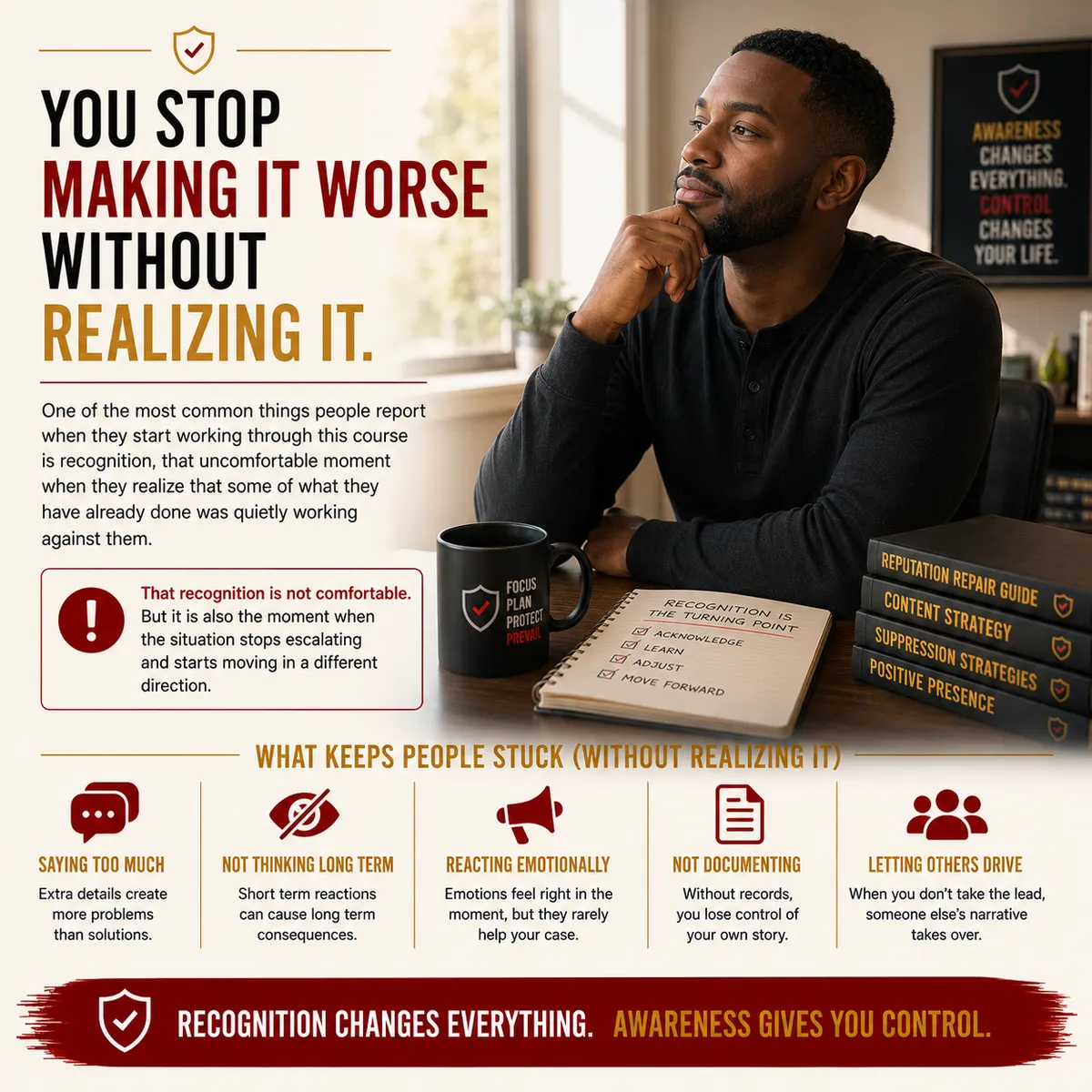
One of the most common things people report when they start working through this course is recognition, that uncomfortable moment when they realize that some of what they have already done was quietly working against them. That recognition is not comfortable. But it is also the moment when the situation stops escalating and starts moving in a different direction.
The Emotional Weight Becomes Something You Can Function Through.

This does not mean the pain disappears. It means it stops making the decisions. The emotional survival tools in Module 4 are practical, not motivational. They are built around what actually helps people maintain clarity and function during a genuinely traumatic experience, not what sounds supportive in a course description.
The Online Narrative Starts to Shift.
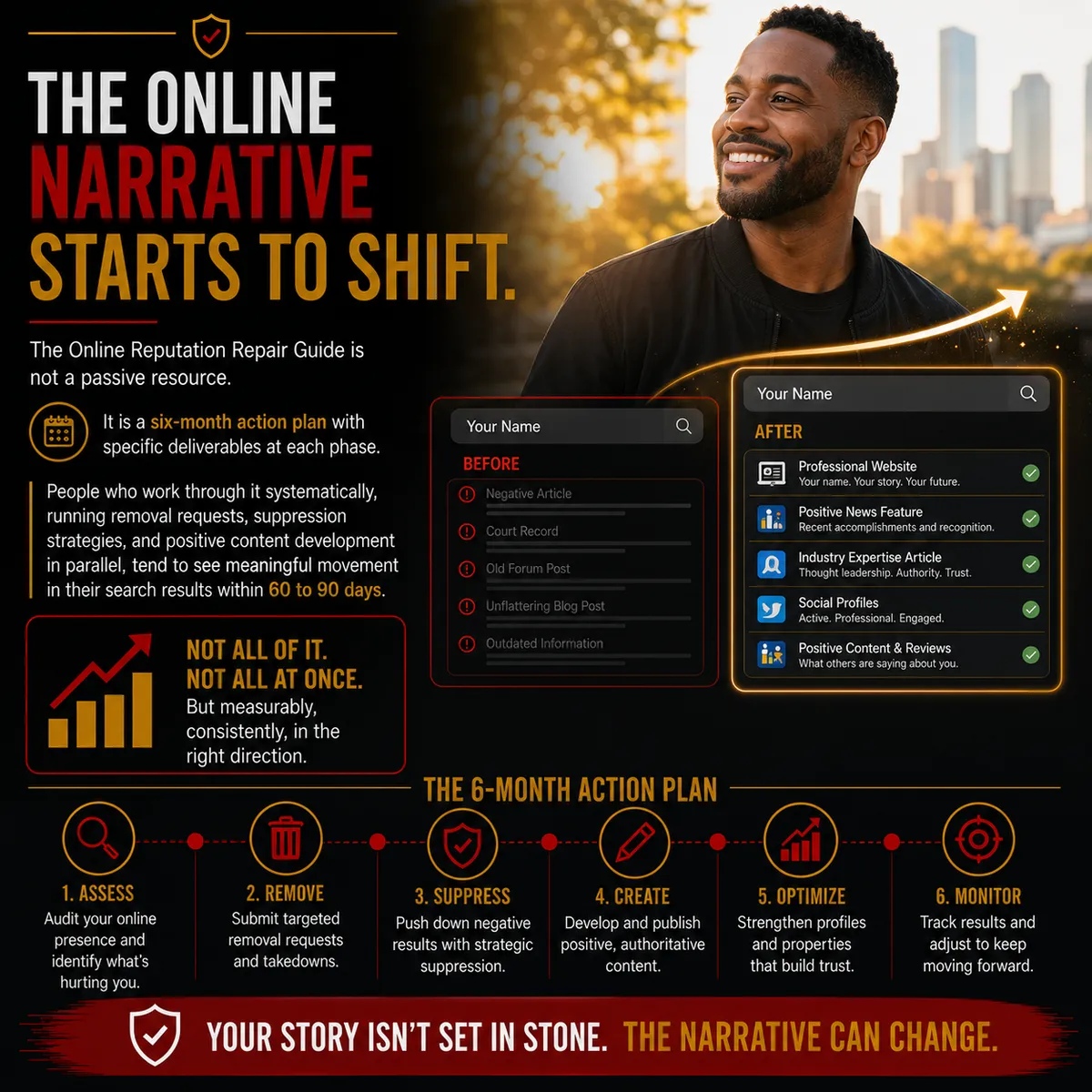
The Online Reputation Repair Guide is not a passive resource. It is a six-month action plan with specific deliverables at each phase. People who work through it systematically, running removal requests, suppression strategies, and positive content development in parallel, tend to see meaningful movement in their search results within 60 to 90 days. Not all of it. Not all at once. But measurably, consistently, in the right direction.
You Come Through This With Something You Did Not Have Going In.

The people who work through this course and apply it fully do not just survive their situation. They emerge with a framework for understanding documentation, legal rights, communication strategy, and digital reputation that serves them well beyond the immediate crisis. That understanding does not expire when the situation resolves. You will be harder to damage this way again. That matters.
THIS IS FOR YOU IF YOU'RE DONE HOPING...
...And You Are Done Being at the Mercy of a Situation You Did Not Create.
You Have Tried to Handle This and It Is Not Getting Better
You have made calls. You have had conversations. You have explained yourself. You have put in real effort. And the situation is still where it is, or worse than it was. That is not evidence that your situation is unwinnable. It is evidence that effort without a framework produces effort, not progress. This course provides the framework.
You Do Not Know What You Are Legally Entitled to Do
Most people in this situation operate with no clear understanding of their legal rights: what defamation law actually covers, when they have grounds for a civil claim, what to document and how, what type of attorney they need, and what is available to them at every budget level. That gap in understanding is not inevitable. This course closes it in plain language, without a law degree required.
You Want to Be Prepared Before Something Like This Happens
Not everyone reading this page is in the middle of a crisis right now. Some of you are here because someone you know went through something like this, or because a case in the news showed you in clear terms how quickly a false accusation can dismantle a life that took decades to build. The framework in this course is just as valuable as preparation as it is as a response. The people who understand how this works are significantly harder to damage this way.
You Are Ready to Do the Real Work and Have the System Run
Building a documented defense, working through the legal and communication frameworks, addressing online reputation damage: all of it takes real effort over real time. The payoff is a system that keeps working. A documented defense that does not disappear. A communication strategy that holds across every phase. A reputation rebuilt methodically, not hoped back into existence. And an emotional foundation that supports everything else. You do the work. The system keeps running.
Honest Answers to Real Concerns
The Questions People Are Afraid to Ask Out Loud. Answered Straight, Without the Sugarcoating.
#1
"I have already made some mistakes in how I handled this. Is it too late for this to help me?"
It is almost certainly not too late. Most people do not respond well in the first hours or days of a false accusation. The instincts are understandable, and the instincts are usually the wrong move. What matters now is not what you should have done. What matters is what you do from this point forward. This course is built around a clear, forward-looking framework that gives you exactly that regardless of where you are starting from. The question to ask is not whether your early moves were perfect. The question is what the right moves are right now. This answers that.
#2
"I am facing something serious, possibly criminal. Can this actually help me?"
If you are facing criminal allegations, the single most important first step is contacting a criminal defense attorney as early as possible. This course does not replace that. What it does is give you a complete framework for everything that surrounds the legal representation: how to document, what not to do, how to communicate, how to manage your reputation, and how to survive the psychological weight of the experience. Many people find that working through this course makes them better-informed clients for the attorney they hire, because they understand the terrain before they walk into it.
#3
"What if this tells me I need a lawyer I still cannot afford?"
This course includes a full lesson built specifically for this reality: legal aid organizations, law school clinics, limited-scope representation, bar association referral programs with reduced-cost consultations, and how to represent yourself effectively in the situations where that is a realistic option. "I cannot afford a lawyer right now" is a real constraint, not a character flaw, and this course takes it seriously. It gives you a clear picture of what is available at every budget level and what you can do independently to protect your position in the meantime.
#4
"You say it is for educational purposes. Does that mean it will not actually help me in my real situation?"
Educational purpose and practical usefulness are not in conflict. The framework in this course, the documentation system, the communication strategy, the legal landscape overview, the reputation management approach, is directly applicable to your situation. What "educational purposes only" means, and what is important for you to understand, is that this course does not constitute legal advice. It cannot replace an attorney who knows the specifics of your jurisdiction and your case. What it can do, and what it is designed to do, is give you the knowledge, the language, and the framework to be your own best advocate at every stage of this process.
Everything You Get
Every Single Thing You Get When You Say Yes Today. Nothing Hidden, Nothing Held Back.
Defend Your Name: The Complete Course
✅ Four focused modules, twenty lessons, each building on the last, with no gaps, no filler, and no prerequisite knowledge required beyond being the person this happened to
✅ A complete legal landscape overview: defamation, false light, your rights in HR and criminal proceedings, how to find and work with the right attorney, and your options at every budget level
✅ A complete communication framework: strategic silence, statement crafting, employer and professional communication, media response, and the scripts for the conversations you will actually have
Bonus 1: The Evidence Documentation Audio Guide
✅ Audio walkthrough of what types of evidence actually matter in a false accusation situation, organized by case type, so you know exactly what to focus on and what to stop wasting time on
✅ Step-by-step guidance on how to preserve each type of evidence correctly so it holds up, including the mistakes that silently compromise what people already have
✅ The Evidence Vault system: four categories, clear organization, structured so an attorney can work with it immediately if and when you need one
✅ The Defense Timeline method for reconstructing a chronological documented account that strengthens your position and surfaces the inconsistencies in the accusation's version of events
Bonus 2: The Online Reputation Repair Guide
✅ The 5-part online audit framework for mapping the full scope of false or damaging content before taking any action, so you know exactly what you are dealing with
✅ Search results strategy: the three-track approach to removal, de-indexing, and suppression, including the content suppression method that pushes damaging results off the first page
✅ Platform-by-platform social media action guide: Facebook, Instagram, X, TikTok, YouTube, and Reddit, with specific reporting steps, removal requests, and engagement strategy for each
✅ Review platform response framework for Google, Yelp, Glassdoor, and specialty directories, with guidance on when to respond and when silence is the stronger position
✅ The 6-Month Digital Reputation Rebuild Plan: month by month, with specific deliverables at each phase from Foundation through Sustain
OUR COMMITMENT TO YOU
You Are Already Dealing With Enough Uncertainty. This Decision Should Not Be One of Them.

We want you to be able to make this decision without risk. If at any point in the first 30 days you decide this course is not the right fit for your situation, send one email and you will receive a full refund. No interrogation. No completion requirements. No conditions.
You either get the framework you came for, or you get your money back. That is the deal.
Important: This course is for educational purposes only and does not constitute legal advice. No specific legal outcome, reputation outcome, or personal result can be guaranteed. Individual results will vary based on the specific circumstances of your situation, the actions you take, and many factors outside the scope of this course.
The 30-day satisfaction commitment applies to the course content itself: if you are not satisfied with the educational framework and material, you will receive a full refund.
About Your Instructor
I Did Not Study False Accusations. He Survived One.

Master Sergeant Everell R. Gustave, Retired
Creator, Defend Your Name
Author, Liar, Liar, Soldier on Fire
My name is Master Sergeant Everell R. Gustave, retired after twenty-five years of service in the United States Army. I dedicated those years to the soldier's creed:
discipline, resilience, loyalty, and the unwavering belief that integrity and truth are worth fighting for, no matter the cost.
I was on the verge of retirement. Ready, finally, to step back from service and be present for my family in the way a career in the military makes difficult. I had one goal I was looking forward to above everything else:
attending my daughter's university orientation in Texas.
My retirement request was denied.
I accepted one final deployment to the Middle East, telling myself it was just one more year. I would fulfill my duty and come home. Instead, in that final deployment, stranded in a foreign land with no allies and no support system, everything changed.
I was falsely accused of something I did not do.
The charge carried the threat of a decades-long prison sentence. I was stripped of my honor, cut off from real support, operating inside a military justice system where the presumption of guilt often outweighs due process.
I could have accepted the position I had been put in.
I chose to fight.
What followed was the hardest thing I had ever done in twenty-five years of military service. I had to understand my legal rights in real time, without counsel, without a roadmap, without anyone handing me the framework I desperately needed. I had to build it myself, under pressure no civilian system can fully replicate, with my freedom, my career, and my legacy hanging in the balance.
I fought my way through it. I came out the other side.
I documented the entire experience in my memoir, Liar, Liar, Soldier on Fire, a raw firsthand account of honor put on trial, the flaws in the military justice system, and what it takes to fight back when the system moves against you. I wrote it not only for soldiers but for every person who has ever been blindsided by a system that presumes guilt before it seeks truth.
And then I built this course.
Because a book tells the story. A course gives you the framework. And the framework, the documentation system, the legal navigation, the communication strategy, the reputation management, the emotional survival tools, is what I had to build from scratch in the worst circumstances imaginable.
You should not have to build it from scratch.
Everything in this course came from that fight. Not from a research project. Not from credentials in a field I observed from the outside. From the lived experience of being falsely accused at the most serious level possible, in one of the most unforgiving institutional systems in existence, and finding a way through it with my integrity and my truth intact.
If you are facing something like what I faced, or something that feels smaller but is no less real to you, this course was built for you by someone who understands what you are carrying in a way that very few people ever could.
Frequently Asked Question
"Is this legal advice?"
No, and we want to be completely upfront about that. This course is educational content, not legal advice. It gives you a framework for understanding your situation, your rights, and your options, but it does not replace an attorney who knows the specifics of your case and jurisdiction. What it does is give you the knowledge to be your own best advocate and, when the time comes, a far more informed client.
"I just found out today. Is it too soon to start this?"
It is the exact right time. The first 72 hours are the most critical window in any false accusation situation, and Module 1 is built specifically for the person who is in the middle of it right now. You do not need to have a clear head or a full picture of what you are facing. You just need to start with Lesson 1.
"I already made some mistakes. Said too much, posted something, confronted the person. Is it too late?"
Almost certainly not. Most people do not handle the first hours of a false accusation perfectly. The instincts are understandable and they are usually the wrong move. This course is built around a forward-looking framework. The question it answers is not what you should have done. It is what to do from right now.
"What if I am facing something serious, like a criminal allegation?"
If you are facing criminal charges, contacting a criminal defense attorney immediately is the single most important step you can take, and this course will tell you that clearly. What the course gives you is everything surrounding that legal process: how to document, what not to do, how to communicate, how to manage your reputation, and how to survive the psychological weight of the experience. Many people find it makes them a better-prepared client when they do sit down with an attorney.
"I cannot afford a lawyer right now. Will this still help me?"
Yes, and we built a full lesson specifically around this reality. It covers legal aid organizations, law school clinics, limited-scope representation, bar association referral programs with reduced-cost consultations, and how to represent yourself effectively when full representation is not yet possible. Not being able to afford an attorney right now does not mean you have no options. This course shows you what those options are.
"How is this different from just searching
Searching online gives you scattered information with no sequence, no prioritization, and no way to know what applies to your specific type of situation. This course gives you a complete, ordered framework that tells you what to do at every phase, from the first hour through long-term rebuilding, in the sequence that actually matters. There is a significant difference between having information and having a system.
"What if my situation is unusual or more complicated than what this covers?"
The course is built around the core framework that applies across the full range of false accusation situations: social, professional, institutional, and criminal. While no course can account for every individual circumstance, the foundational principles of documentation, legal awareness, communication strategy, and reputation management apply regardless of the specific details of your case. And the legal module specifically addresses how to find the right type of professional help for situations that require it.
"How long does it take to get through?"
Most people work through one module at a time over the course of a week or two. But the course is structured so the most urgent material comes first, and you can begin applying what you learn from the very first lesson. If your situation is active right now, Module 1 can be worked through in a single sitting.
"What format is it in? Do I need to watch videos?"
No video. Every lesson is delivered in text and audio, designed to work in the margins of a real schedule. Read it during a sleepless night. Listen during a commute. Work through a lesson in twenty minutes between other demands. No dedicated screen time required, no special software, no equipment.
"What if I go through it and decide it is not right for me?"
You have 30 days to decide. If at any point in the first 30 days you feel this course is not the right fit for your situation, send one email and you will receive a full refund. No questions, no conditions, no runaround.
"Who is this course not for?"
This course is not for attorneys or legal professionals looking for case strategy. It is not for people with a casual or academic interest in the subject. It is not a substitute for an attorney in a formal legal proceeding. And it is not for anyone looking to make, amplify, or sustain a false accusation against someone else. It was built entirely for the person on the receiving end of something they did not do.
The Bottom Line
Every Day You Spend Without a Framework Is a Day the Other Side Has a Head Start on You.
Right now, while you are reading this, the documentation window is open. The legal window is open. The reputation window is open. All of those windows close. And some of what closes them cannot be reopened, no matter how good your case is, no matter how clear the truth is, no matter how much effort you put in later. The sequence matters. The timing matters. The framework matters right now.
When you enroll today, you get immediate access to all four modules of Defend Your Name, the complete strategic, legal, and communication framework built specifically for the person who is tired of reacting and ready to respond, who is done hoping the truth comes out on its own and ready to build the kind of documented, strategic defense that actually holds up in the real world.
You get The False Accusation Response Checklist, a time-organized, specific, immediately usable action protocol for the most critical 48-hour window of the entire experience. Every critical action, every critical mistake, clearly marked, nothing left to guess.
You get The Online Reputation Repair Guide, a complete five-part system for assessing and addressing false information across every major online platform, plus a six-month rebuild plan with specific deliverables at each phase.
And you get a 30-day satisfaction commitment that takes all the risk out of the decision.
"The people who come through a false accusation with their career, their reputation, and their life intact are not the ones who were more innocent than you. They are the ones who learned the framework and used it. This course is that framework. And it is here right now."
How many more decisions are you willing to make by instinct in a situation where instinct is the most expensive tool in your toolkit? How many more days are you willing to go without a documented defense, without a communication strategy, without knowing what you are actually entitled to do?
The framework is built. The course is ready. Your name is worth defending.
Enter Your Details Below To Get
Instant Access To Everything Inside
Soldier on Fire — Defend Your Name. Reclaim Your Story.
Home | Coaching | Contact Gus | Support the Awareness Initiative
Read the Memoir on Amazon | Get the Survival Guide | Shop Barnes & Noble
Affiliate disclosure: Purchases through these retailer links may earn Soldier on Fire a commission at no extra cost to you. As an Amazon Associate I earn from qualifying purchases.
Facebook | Instagram | YouTube | TikTok | Substack
© 2026 SOLDIER ON FIRE LLC
Terms & Conditions | Privacy Policy | Testimonial & Results Disclosure | Product Disclaimer
Affiliate Compensation Disclosure | No Affiliation with the FTC | Anti-Spam Policy
This site is operated and maintained by SOLDIER ON FIRE LLC. The content presented is for educational and informational purposes only. Nothing on this page, our website, or any of our content is a promise or guarantee of results. Your success depends on your own effort, commitment, and ability to follow through. Results shared in our materials may not be typical and are not guarantees. Always read our full disclaimers and terms linked below.