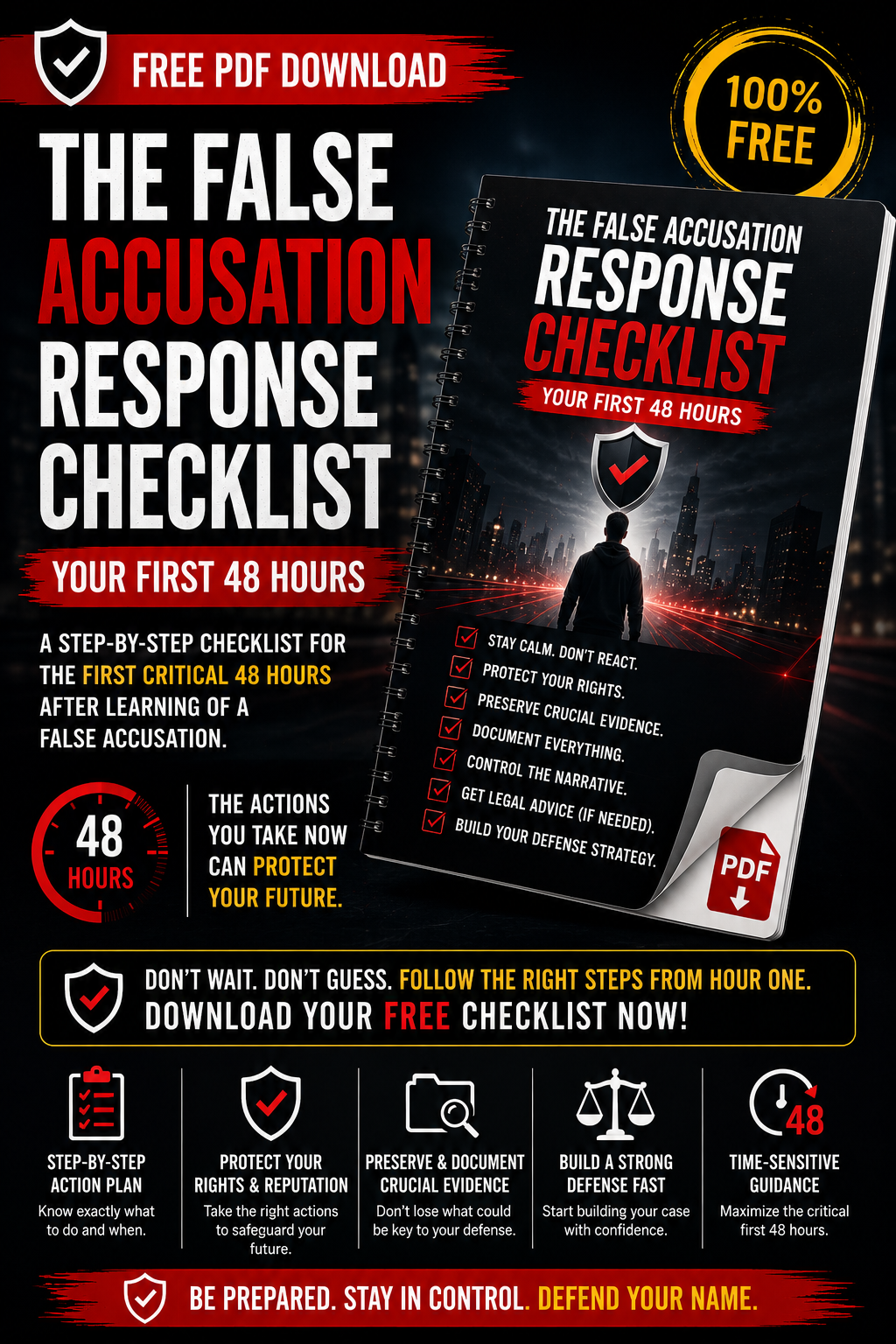
You just found out someone accused you. Every part of you wants to act right now. Stop. What you do in the next 60 minutes will either protect you or cost you. Read this first.
Get Instant Access to My FREE False Accusation Response Checklist: Your First 48 Hours
Get the step-by-step action protocol for the most critical window of any false accusation situation, including exactly what to do, what to avoid, and what to say when the people around you start asking questions.
If you just found out someone said something about you, you have no idea what to do first, and you feel like every move you make might make it worse... read this before you do anything else.
Get Instant Access to My FREE False Accusation Response Checklist: Your First 48 Hours
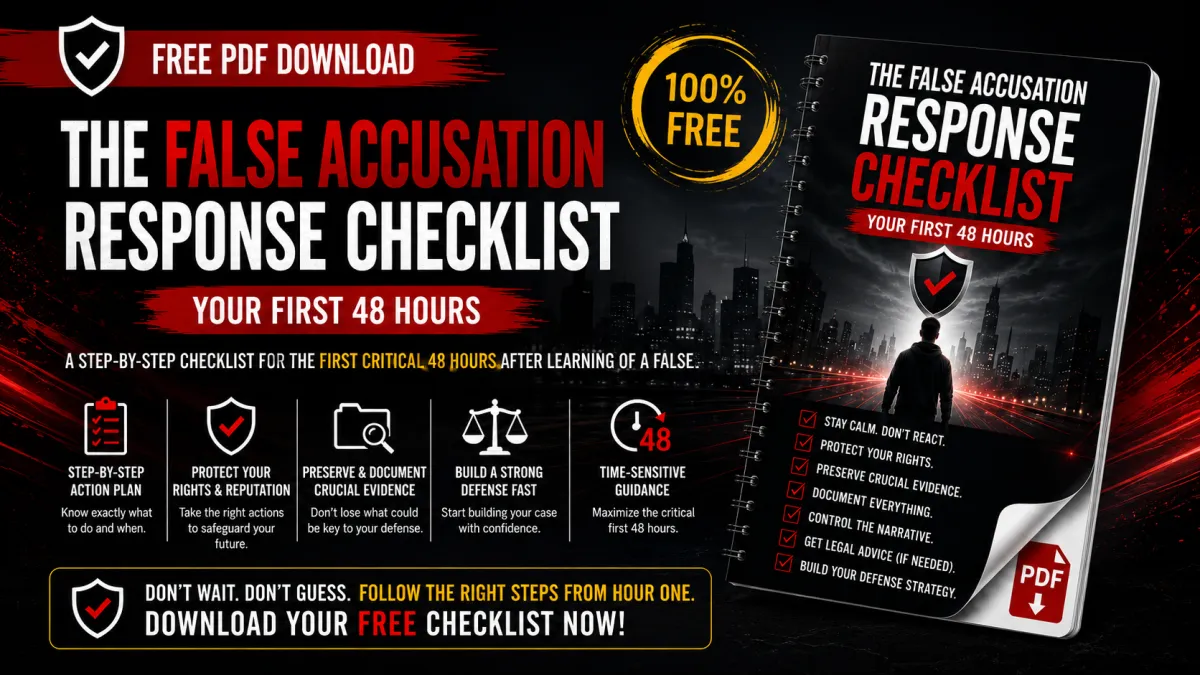
Get the step-by-step action protocol for the most critical window of any false accusation situation, including exactly what to do, what to avoid, and what to say when the people around you start asking questions.
Scroll down for a full preview of everything inside the checklist
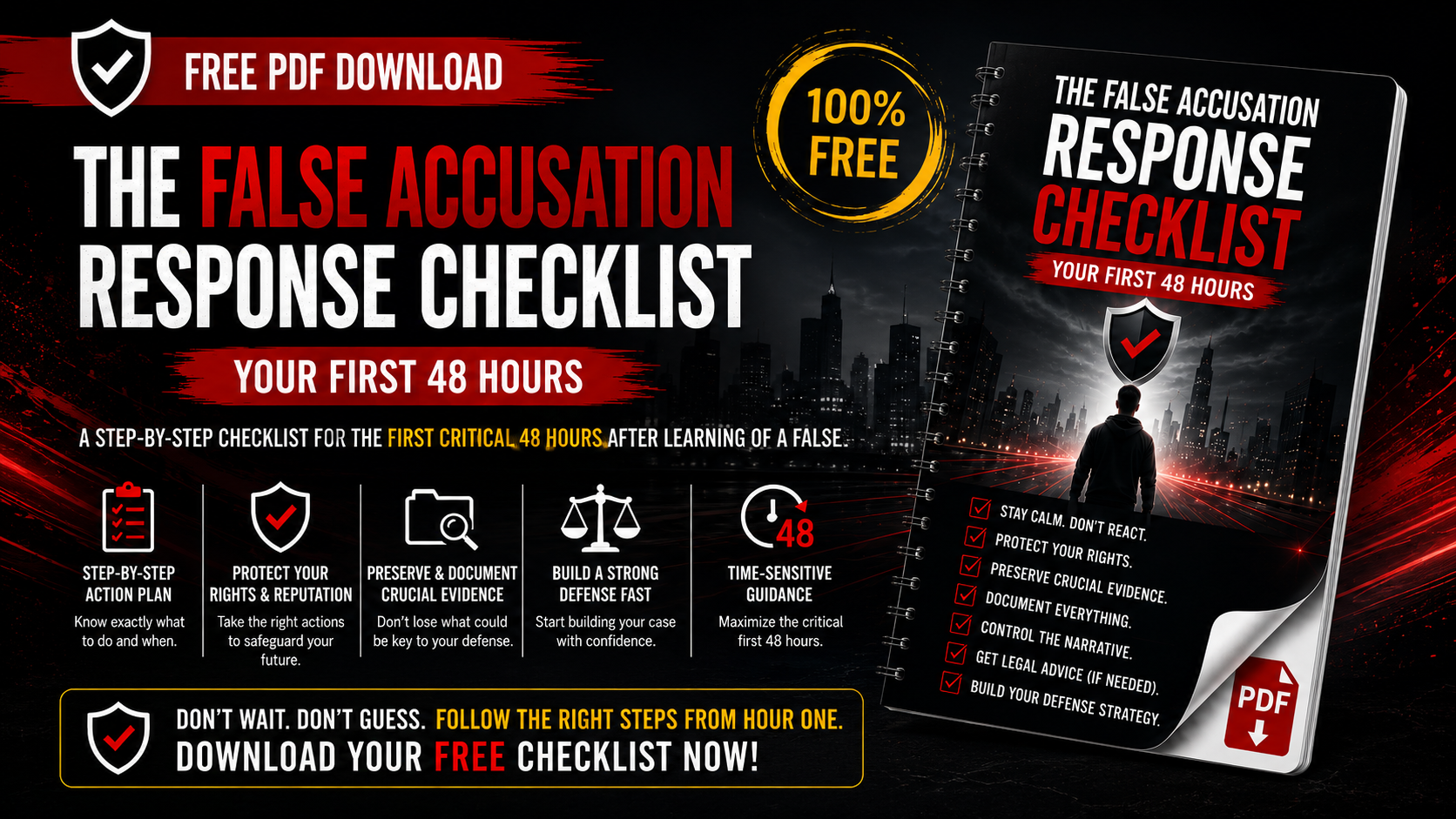
What You Get Instant Access To:
The False Accusation Response Checklist: Your First 48 Hours
Inside the Checklist #1
Find Out Why the First 60 Minutes Are the Most Consequential Window in the Entire Experience, and What to Do In Them
The moment you find out someone has made a false accusation against you, your body goes into crisis mode. Your hands go cold. Your mind races. Every instinct you have is screaming at you to act, to confront, to call people, to post, to fix this right now. This is the most dangerous 60 minutes of the entire situation, and what you do in them, or do not do, will shape everything that comes after. Section One of this checklist gives you a specific, ordered protocol for the first hour, so the decisions you make in those 60 minutes are the right ones, not the ones your panic chose for you.
✔️ The three things to do in the first 60 minutes that start protecting you immediately, even before you have a full picture of what you are dealing with
✔️ The four actions that feel instinctively right in the first hour but almost always make the situation significantly harder to manage from this point forward
✔️ How to identify what type of accusation you are dealing with, social, professional, institutional, or criminal, because the right response depends entirely on understanding which situation you are actually in
Inside the Checklist #2
Get the Exact Documentation Protocol That Starts Building Your Defense From Day One, Before You Have an Attorney or a Plan
Most people who are falsely accused spend the first 24 hours reacting. The people who come through this with their career and reputation intact spend those same 24 hours documenting. There is a window for documentation that opens the moment you find out, and it closes faster than most people realize. Section Two of this checklist walks you through exactly what to capture, how to preserve it correctly so it remains useful in any formal proceeding, and what categories every documented defense needs to cover. You do not need an attorney to start this. You need this checklist.
✔️ The four categories of evidence that matter in a false accusation situation and which to prioritize capturing first based on your specific circumstances
✔️ How to preserve digital evidence, including messages, posts, and records, correctly so it stays intact and usable if your situation escalates to a formal process
✔️ The one documentation habit to start immediately that most people skip and almost always wish they had started on day one
Inside the Checklist #3
Discover the 5 Rules You Must Not Break at Any Point in This Process, and Why Breaking Even One of Them Can Cost You More Than You Realize
There are certain moves that feel completely justified when you are falsely accused. They feel like the right thing to do. They feel like what any reasonable, innocent person would do. And some of them can damage your position more severely than the original accusation did. Section Three lays out the 5 Rules You Must Not Break, the lines that people who have navigated this situation successfully all agree you should never cross, regardless of how justified crossing them feels in the moment.
✔️ The response that feels like setting the record straight but is often the single most damaging move a falsely accused person can make in the first 48 hours
✔️ The conversation most people have in the first day that they later wish they had handled very differently
✔️ What to do instead of the moves that feel right, so you are never left choosing between acting and protecting yourself
Inside the Checklist #4
Learn the Word-for-Word Scripts for the Conversations You Are Already Dreading, So You Know Exactly What to Say When Someone Asks You Directly
The moment people around you start finding out, the questions begin. Colleagues. Your employer. Family members. Possibly media. And in every one of those conversations, the words you choose matter enormously. Section Four gives you word-for-word scripts for the most common questions you will be asked in the first 48 hours, including how to respond when someone asks directly, how to hold a position of strategic silence without appearing guilty or evasive, and how to ask for support without oversharing in ways that could complicate your situation later.
✔️ The exact language to use when an employer, colleague, or family member asks you directly about the accusation, before you have a full strategy in place
✔️ How to hold a position of strategic silence without appearing guilty, evasive, or like you have something to hide
✔️ What to say when someone offers to help, so the support you receive actually helps your situation instead of accidentally complicating it
Inside the Checklist #5
Get the Emotional Survival Layer That Keeps You Functional and Clear-Headed Through the Most Psychologically Demanding Experience You Have Likely Ever Faced
Being falsely accused is a genuinely traumatic experience. The shame of having your name attached to something you did not do. The rage at the injustice of it. The fear of what this is going to cost you. The isolation of going through something most people around you do not know how to hold space for. All of it is real, all of it is valid, and all of it without some structure to hold it can take over the decisions that need a clear head. The Emotional Survival Layer in this checklist gives you a framework for staying functional during the first 48 hours, not by suppressing what you feel, but by giving it a container so it stops running your strategy.
✔️ The six most common emotional experiences people have in the first 48 hours of a false accusation, and what each one is actually asking for strategically
✔️ The daily minimum habits that keep your thinking clear and your presentation steady during the part of this where everything feels most out of control
✔️ A notes section for capturing the essential facts of your situation while your memory is sharpest and the details are freshest
Click The Button Below
To Download Your Free Copy
Get Instant Access — It's 100% Free. No Credit Card. No Catch.
© 2026 SOLDIER ON FIRE LLC
Terms & Conditions | Privacy Policy | Testimonial & Results Disclosure | Product Disclaimer
Affiliate Compensation Disclosure | No Affiliation with the FTC | Anti-Spam Policy
This site is operated and maintained by SOLDIER ON FIRE LLC. The content presented is for educational and informational purposes only. Nothing on this page, our website, or any of our content is a promise or guarantee of results. Your success depends on your own effort, commitment, and ability to follow through. Results shared in our materials may not be typical and are not guarantees. Always read our full disclaimers and terms linked below.